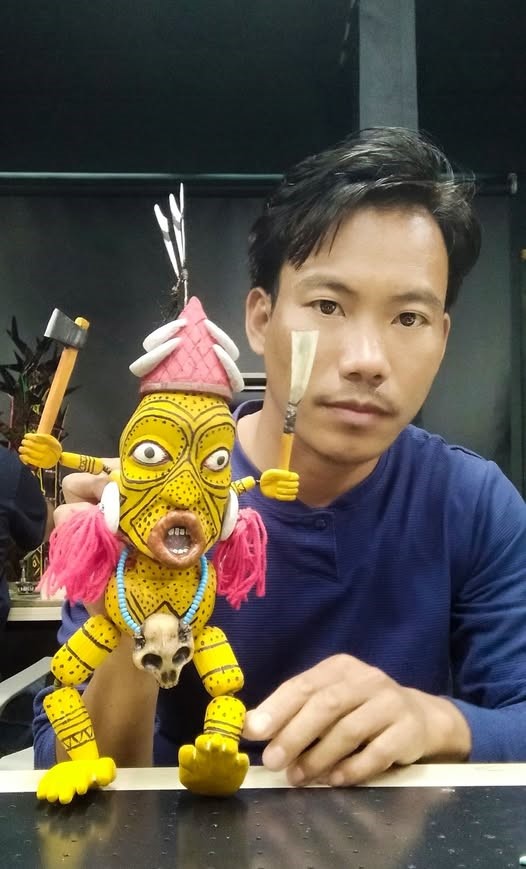
A two month long workshop has been taking place at Srishti Manipal Institute of Art Design and Technology (SMI), in Bengaluru in India, to proceed with the production of a short film. This will be the first story adapted for animation from one of the most secluded corners of India, from a village perched high in the Patkai Hills near the international border with Myanmar. The workshop, has been organised as a collaboration between SMI, Adivasi Arts Trust (UK) and Bryan Guinness Charitable Trust (UK), and it has assembled a team of four undergraduate students of design and two young artists the Wancho community. The team is led by Vijay Punia, a teacher of animation at the institute.
The project has taken a long time to unfold and to reach this stage. It began in Kamhua Noknu, one of the largest paramount villages constructed of wood and bamboo houses of the Wancho community in the upland tracts of Longding District, in Arunachal Pradesh. I arrived in the village in 2019 to record some stories recollected by the elders of the village for a postdoctoral study. I am a filmmaker and cultural researcher from the United Kingdom, and I have a lifelong connection to India. The Stories of our Ancestors was at first hosted by the Department of Anthropology at North-Eastern Hill University, and 32 stories were recorded in Kamhua Noknu and a few of the neighbouring villages. Jatwang Wangsa, who is a teacher at the local school was able to translate the stories for our co-authored book: Myth Memory and Folktale of the Wancho Tribe of Arunachal Pradesh (Niyogi Books 2024). These stories, passed down from the ancestors through oral retellings from generation to generation were retold as entertainment, and contain guidance on how to interrelate with other human and nonhuman beings.
The second phase of the project was a workshop to introduce young people in the village to the medium of animation. I travelled across India in 2020 equipped with cameras, laptops, film lights, a green screen and the materials to model animation characters: aluminum wire, modeling clay and other stuff that would not be available in the village. The workshop took place in the school office, which was closed during the covid pandemic, and we had the benefit of a secure place to work and a solar-power back up power system, whereas the mains electricity was weak and erratic in those remote hills. Following the announcement, 16 curious young people turned up on the first day of the workshop. They soon discovered that to create animation is a slow, complex process, and over the course, a core group of 5-6 regular participants became the first team to initiate the project development. The research and workshop was documented and edited for a film, “Myths of the Wancho”[1] (2021).
The Wancho Story of the Gourd was selected for the adaptation from the resource of recorded stories because it represents several significant customs of the Wancho cultural tradition. It is a combination of two narratives, and the plot is not confined by the typical linear narrative structure. Existing exclusively in the oral form, these poetic recollections are simultaneously fragile, dynamic and vibrant. The Wancho storytellers continually improvised, reorganized, and recreated the elements of the myths for their audience, the situation, and according to their personal expression.
The story, retold by Jatwang’s father, Ngamchai Wangsa (late), was an organic meandering narrative that reimagined the divine creation of the Wangham, who was the first chief of the village[2]. The Story of the Gourd that began in the sky and culminated with the magical gourds germinated in the earth, traces the evolutionary history from a space of primal integrity to describe the relationships of environment and community; disputes over territory, the livelihood activities of hunter-gatherers, traditional agriculture, social order and village governance.
An Animation Workshop was organised at Department of Anthropology at North-Eastern Hill University in March 2021. The event invited students, scholars, young media professionals from the region and 8 Wancho participants to the pre-production phase for interpreting the story for a short film. For two weeks the team discussed and debated the intricate details of the story; they created a script, storyboard, character designs and test animation sequences. This workshop was also documented and edited for a film[3].
The flow of creation was subsequently interrupted when the project was mismanaged at the University, and it has taken several years to get back on track with some financial support from Bryan Guinness Charitable Trust. Vijay Punia had been a part of the project since his role as a resource person during the workshop at NEHU, and he could see the importance of getting it finished. The new team has assembled during the vacation period at Shrishti; they have created the animation models by hand and they have utilized the facilities of the stopmotion studio at the institute to design, create and film each shot. The project has required meticulous planning through which the entirety of story, action and shot composition must be deconstructed, worked out and prepared. Online sessions have helped me to traverse great geographical distances to communicate with them, and this week I am travelling to Bengaluru to celebrate their achievement. The short film is a melding of tradition and innovation; the words of the Wancho ancestors adapted for young audiences will be retold in Wancho, Hindi and English. It will belong within the “Stories of our Ancestors” series to present a glimpse into some of the animist narratives of the earth.
[1] Myths of the Wancho, available here: https://youtu.be/ipB3EVHMpN4
[2] The recording is available here: https://youtu.be/G6D1ItT4_78
[3] The Wancho Animation Workshop and the Story of the Gourd, Available at: https://youtu.be/bQzWmoIwKv4